Maritime Chokepoints Are Becoming the New Geopolitical Main Stage
byFelix Kleiner
Felix KleinerVienna, Austria
Felix Kleiner writes at the intersection of geopolitics and supply chain management. His analyses examine trade flows, critical dependencies, nearshoring dynamics and the strategic implications of global risk events for European industrial and manufacturing companies.
More than 80 to 90% of global merchandise trade moves by sea1. Bottlenecks such as straits and canals act as the supply arteries of the world economy: if these maritime chokepoints are blocked, world trade faces a cardiac arrest with extreme consequences for the global economy. As early as 1890, the naval strategist Alfred Thayer Mahan put it aptly:
"Whoever rules the waves rules the world."
By this he meant not only war fleets, but above all the key points of the shipping routes. Whoever controls these so-called chokepoints can starve out entire economies without firing a shot2.
In the past, the world's sea connections enjoyed a stability secured by Western hegemony. Today, however, in an era of renewed great-power rivalries, the oceans and their bottlenecks are turning into the main stage of geopolitical conflict. Events such as the blockage of the Suez Canal in 2021 or the recent attacks in the Red Sea have exposed the vulnerability of trade routes. Great powers like China and regional actors such as Iran or rebel groups (for instance the Houthis in Yemen) increasingly use maritime bottlenecks as leverage to extract political or economic advantage. The open sea is thus developing, figuratively speaking, from a free "blue ocean" into a contested zone.
In what follows I analyse how the shift in the world order has raised the importance of maritime chokepoints, which strategic bottlenecks are currently most in focus and who the winners of this development are. A case study on China's creeping blockade in the South China Sea finally illustrates the new dynamic.
The Shift in the World Order: From Balance to Bloc Formation
Before: Hegemonic order and guaranteed sea lanes
In the second half of the 20th century, and especially after the Second World War, the US and its allies (for example NATO) provided a largely stable maritime security system. The US Navy acted as the "policeman of the seas" and ensured that the most important trade routes stayed open3, 4. Historically, other sea powers had previously taken on this role (Portugal in the 16th century, the Netherlands in the 17th, Great Britain in the 18th and 19th). From the start of the 20th century it was primarily the United States that secured the sea lanes, a costly task, but a worthwhile one for the hegemon, since it benefited most from free trade itself.
Under this US-led system, underpinned by international agreements such as the UN Convention on the Law of the Sea (UNCLOS), maritime chokepoints generally stayed open for civilian traffic. Clear power relations deterred potential troublemakers, and incidents (such as piracy) were contained by multinational naval operations. Even during the Cold War, individual crises aside, there were no deliberate blockades of important straits by the superpowers. The "balance of terror" enforced restraint, and economic interdependence did its part to avoid open conflict at sea. In short: stable power relations and a recognised ordering power guaranteed the security of maritime trade flows5.
Now: A multipolar world and the return of the "zone of violence" at sea
With the rise of new powers and the erosion of the old order, the picture has turned. We live in a multipolar world in which no single power can, and in part will, still secure all the world's sea lanes. International regimes have been weakened: institutions such as UNCLOS still exist, but their enforcement often fails in the face of power politics. One example is the 2016 ruling of the Hague arbitration court, which declared China's extensive claims in the South China Sea illegal. Beijing ignores it to this day6, 7.
The constitutional lawyer Carl Schmitt once described spaces free of rule as a "zone of violence". Exactly this dynamic is now returning to the world's oceans: open sea areas without an effective ordering authority become the stage for power struggles in which rules and boundaries are re-calibrated or disregarded. Four central drivers heighten the geopolitical volatility of maritime chokepoints:
01
Open spaces - a low barrier to entry for disruption
The world's oceans are vast and hard to control. With comparatively little effort, troublemakers can achieve enormous effect. Pirates in speedboats, terrorists with sea mines or missiles, even a single stricken freighter, all of these can sever shipping arteries. Whoever occupies or threatens a strategic bottleneck can paralyse trade without having to launch an invasion. The fact that Houthi rebels in Yemen attacked dozens of merchant ships with a handful of drones and missiles in 2023/24 forced shipping lines to change course by thousands of kilometres. This asymmetric vulnerability makes maritime chokepoints an attractive target even for militarily inferior actors8, 9.
02
Globalised trade structure - maximum vulnerability
Today's world economy runs just-in-time and is extremely interconnected. Even short interruptions of important sea lanes produce immediate global effects. In 2021, six days of blockage in the Suez Canal were enough to disrupt supply chains worldwide. Around 90% of world trade volume flows by sea, a substantial part of it through bottlenecks such as Suez, Malacca or Hormuz10. When such a bottleneck is blocked, transport times and costs jump sharply, and goods arrive late or not at all. The recent attacks in the Red Sea illustrate this: for fear of Houthi missiles, many ships rounded Africa, with two extra weeks and 1.5 million EUR in additional costs per voyage as the result. Carmakers such as Tesla and Volvo even had to temporarily close plants for lack of components11.
03
No ordering power - no red line on blockades
While freedom of navigation formally applies on the high seas, in practice there is no enforceable "world police" for the trade routes. The US still commands by far the most powerful navy and sees itself as the guarantor of free sea lanes. But its omnipresence is coming under pressure: regional powers test the limits without automatically having to fear intervention. Take the South China Sea: China intimidates its neighbours with coast guard and militia forces, while Washington cannot effectively step in beyond notes of protest and symbolic transits. Similarly, Iran was in the past able to temporarily detain oil tankers in the Strait of Hormuz without serious consequences. Because there are no longer any clear "red lines" as there were in the Cold War, uncertainty and the risk of escalation at maritime chokepoints are rising.
04
Dual use of maritime infrastructure - civilian and military
The infrastructure of the seas (ports, ships, undersea cables) primarily serves civilian purposes, but in a conflict it can immediately be repurposed for military ends. A current example is China's "maritime militia": nominally civilian fishing boats and crews are deployed as an extended arm of the navy12, 13. This grey-zone potential makes countermeasures difficult, because an attack on apparently civilian ships would be legally fraught under international law, while at the same time the militias can severely disrupt foreign naval operations. Commercial ports, too, suddenly become strategic: Chinese investments from Sri Lanka to Africa create potential naval bases. The 2022 sabotage of the Baltic Nord Stream gas pipeline painfully demonstrated just how vulnerable critical maritime infrastructure is.
Maritime chokepoint
Interactive map: maritime chokepoints worldwide - click for a profile
Chokepoints in the Current World Situation
More than 50% of global seaborne trade is currently potentially vulnerable in a few regions that are crystallising into geopolitical tension zones. Many global goods flows concentrate on a handful of central bottlenecks. About half of all significant maritime chokepoints lie in Asia, which underlines the key role of the Indo-Pacific region. But Europe and the Middle East are exposed as well.
The simultaneous rise in geopolitical tensions at precisely these nodes (the Middle East, the Indo-Pacific, the Black Sea region) hints at why maritime chokepoints are becoming the new main stage of world politics. Even in the short term, disruptions lengthen delivery times; in the long term, companies could be forced to fundamentally restructure their supply chains, a tectonic shift in world trade.
Geopolitical conflicts and even climate factors have a considerable influence on shipping bottlenecks. Open sea lanes can no longer be taken for granted. Large parts of world trade concentrate on a few critical points, and it is precisely there that tensions are increasing. Delivery times already lengthen noticeably during crisis periods; over the long run this could force companies to make their logistics networks more robust and diversified, for example through more inventory or the relocation of production chains.
New Winners: Who Benefits from the New Maritime Geopolitics
The shift in the balance of power at sea creates new winners. Actors who can capitalise on the importance of the chokepoints or strengthen their position:
States with sea access and fleet capacity
Countries with strong naval forces and merchant-fleet capacity can project power and defend their interests in the new situation. China above all: in just two decades the People's Republic has built a vast navy.
~370
warships in China - the largest fleet in the world14
~290
deployable ships in the U.S. Navy
Many units are smaller and shorter in range than those of the U.S. Navy, yet China's ability to show presence in Asian waters increasingly deters rivals. India, Japan and other littoral states are strengthening their navies as well. Overall, a new maritime arms race is taking shape: whoever has access to the sea and invests in ships gains strategic room for manoeuvre. At the same time, the US retains the global upper hand in terms of striking power despite its smaller ship count, thanks to aircraft carriers, submarines and bases around the world. But its lead is shrinking in relative terms.
States at strategic chokepoints
Geography is once again becoming geopolitics. Countries that control important straits or lie along them gain bargaining power.
Egypt
Collects transit fees of around 7 to 8 billion US$ a year at the Suez Canal15. Strong interest in security in the Red Sea.
Turkey
As the gatekeeper at the Bosphorus, it can steer naval access to the Black Sea via the Montreux Convention, a lever against Russia and NATO.
Singapore
Benefits from its position on the Strait of Malacca both economically (a mega-port) and in security terms (close cooperation with the US).
Djibouti
Established at Bab al-Mandab as a hub for international military bases. Earns revenue and takes on a protective-power role.
Overall, the principle holds: proximity to chokepoints gives states leverage in world politics. They can levy transit fees, enter alliances or, in the extreme, threaten closure. The new importance of the straits gives these countries a stage on which to bring their otherwise limited power to bear globally.
Private actors
Not only states, but also the private sector and non-state actors are part of the maritime power shift, in part as beneficiaries. Shipping lines and logistics giants are among them: in times of crisis the market often concentrates even more strongly on a few large companies. When small shipping providers avoid risky routes, groups such as Maersk, MSC or COSCO step in, having the capital and the fleets to serve unsafe waters as well. They can charge high freight rates for their services; in 2021/22, for instance, container prices exploded, handing large liner companies billions in profit.
Insurers are another winner: war-risk premiums rise sharply during conflicts at sea. After the Houthi attacks, the insurance premium per transit nearly doubled in 202516. Security firms benefit too: demand is rising for private armed onboard teams, maritime security consultants and escort vessels. Finally, commodity and financial speculators emerge as indirect winners: every shortage drives prices up, and whoever bets on it or controls alternative sources of supply pockets the gains.
Actors who deliberately exploit instability
Among the invisible winners are those who actively stoke instability to pursue their own goals. Revisionist states such as China, Russia or Iran have recognised that they can harm the established powers and secure their own advantages by pinpricks at maritime chokepoints17. They often operate in the grey zone: in 2022 Russia deployed drones to sabotage Ukrainian port infrastructure and obstruct grain exports across the Black Sea. Iran uses proxies (the Houthis) to create unrest on one of the most important oil routes.
Non-state violent actors likewise profit from chaos: in 2023, 120 pirate attacks were recorded worldwide, and any conflict that pulls navies away can push such figures higher. In 2023 the Houthi rebels openly justified their attacks on international ships "in solidarity with Palestine", placing local violence in a global context. For such actors, maritime chokepoints are attractive targets, because this is where the vulnerability of the great powers is highest.
Case Study: China Selectively Blockades the South China Sea
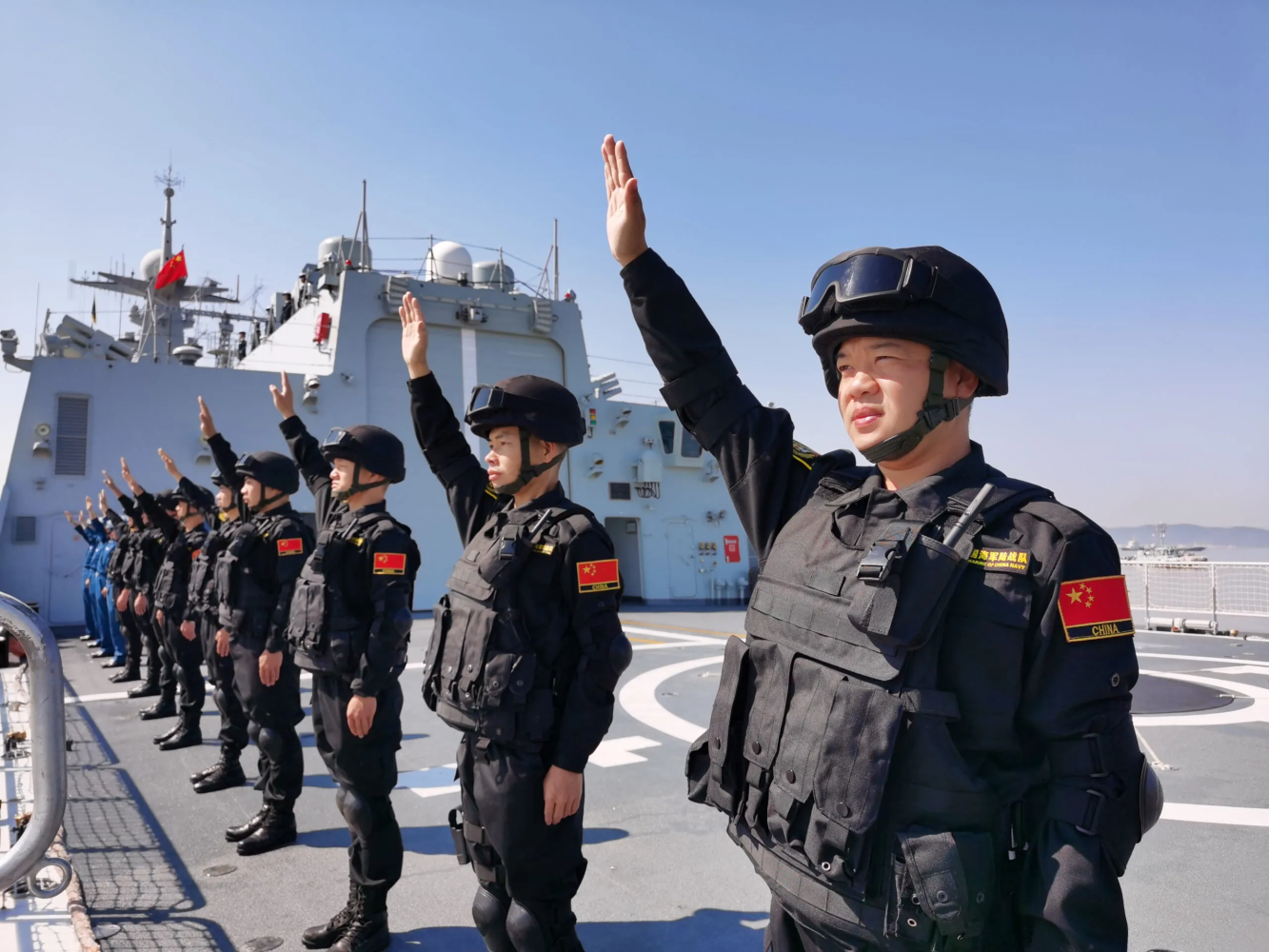
Chinese marines aboard a PLA Navy warship
To close, a scenario that makes the dynamics described above tangible. The South China Sea (SCS) already counts as one of the most contested maritime spaces in the world. The question is: what if China effectively takes control of this sea without open war, step by step, administratively disguised?
#1
Starting point: geostrategic importance and current status
The South China Sea is geostrategically extremely important. About 3 trillion US dollars in goods are transported through this maritime region every year. The sea also holds rich fishing grounds and potential oil and gas deposits. Several littoral states, such as Vietnam and the Philippines, raise claims that overlap with China's far-reaching claim (the "nine-dash line", around 90% of the SCS). An international arbitration court in The Hague dismissed China's historical territorial assertion as unfounded in 2016.
3,200
acres of new land reclaimed since 2013 (~13 km²)
$3 trn
annual trade volume through the SCS
Beijing, meanwhile, has created facts on the ground: since 2013, China has reclaimed more than 3,200 acres of new land in the SCS and built bases there with ports, runways and radar stations. Many of these artificial islands are now equipped with military installations such as anti-aircraft and anti-ship missiles.
#2
Scenario: selective control below the threshold of war
China pursues a gradual expansion of its influence in the grey zone below the threshold of war (the "salami tactic"). In this way Beijing extends its control without provoking open war:
Administrative steps
Institutionalising the claims through new administrative bodies. Beijing places the SCS under the city of Sansha (Hainan) and in 2020 created two new districts for the Paracel and Spratly Islands. Disputed locations are given Chinese names and marked with buoys or lighthouses.
Legal underpinning
Unilateral laws legitimise China's conduct. The Coast Guard Law of 2021, for instance, permits the use of armed force against foreign ships and the destruction of foreign structures on reefs claimed by China.
Paramilitary pressure
Instead of the navy, China's coast guard and maritime militia (disguised fishing boats) patrol the claimed waters continuously. They push foreign boats away, disrupt fishing and exploration and demonstrate a constant presence.
Targeted blockades
Beijing uses blockades to wear down rivals on the spot. Chinese ships at Second Thomas Shoal, for example, regularly block the supply boats of a Philippine outpost.
Faits accomplis
By building out military and civilian infrastructure on disputed islets, China creates accomplished facts. Each step looks small, but together they form a dense web of Chinese control.
#3
Economic consequences for the region and the world
Regional effects
Littoral states such as Vietnam, the Philippines or Malaysia feel direct disadvantages. Their fishermen lose income when China's fleets occupy traditional fishing grounds. Planned oil and gas projects have been halted for fear of Chinese intervention; in 2018, for example, Vietnam broke off a major offshore drilling project under pressure from Beijing, which cost the firms involved hundreds of millions of US dollars19.
Global consequences
Nearly half of the world's crude oil and a significant share of LNG and merchandise trade flows through the SCS. A severe disruption of this route would send global supply chains reeling. Insurers could declare the area high-risk, similar to the Gulf of Aden, where after 2008 premiums per transit exploded from around 20,000 to 150,000 USD. A one-week closure of the Strait of Malacca would, by some estimates, cause more than 60 million USD in additional costs.
#4
Political dynamics: responses from ASEAN, the US, China and the EU
ASEAN
The Southeast Asian states are divided on the SCS question. The Philippines and Vietnam protest loudly, while China-friendly members block common action. ASEAN has been negotiating a code of conduct with China for years, and one is now meant to be in place by 2025/26, though whether Beijing will respect it remains doubtful.
USA
For Washington, the credibility of its alliance guarantees is at stake. A 1951 treaty obliges the US to come to the aid of the Philippines in an emergency20. To deter, the US conducts naval patrols (FONOPs) and has reinforced its military presence21. Yet a delicate touch is required: too confrontational a posture carries the risk of escalation.
China
From Beijing's point of view, the SCS is one of its own core interests. The waters form a protective belt around Hainan, where China's nuclear submarine fleet is stationed. Beijing insists it is merely exercising its legitimate rights. China's calculation: no rival, not even the US, will dare to go to war over a few reefs.
EU
The EU has no territorial claims in the SCS but sees international law and freedom of navigation at risk. European diplomats support the ASEAN states and insist on compliance with UNCLOS and the 2016 Hague ruling. Europe acts cautiously so as not to strain relations with Beijing.
#5
Strategic calculus: implications for global order and security
International law vs. power politics: China's disregard of the Hague arbitration award and the enforcement of its claims by fait accompli set a dangerous precedent: the rule-based order erodes when the law of the strongest sets the tone. At the same time, the alliance system is being put to the test, since the US must stand by its ally or risk a loss of trust across Asia.
Power shift and economic risks: Were China to bring the SCS de facto under its control, the balance of power in Asia would shift in its favour. The US Navy would be pushed out of China's vicinity; neighbours would have to accommodate Beijing or rearm massively. Until now, international norms and the US presence guaranteed open sea lanes; in future a single power could control access. Ultimately, the SCS stands symbolically for whether the world order in the 21st century will be shaped by law or by power, a course-setting decision of global consequence.
Sources
CSIS (2024) State of Maritime Supply Chain Threats
gCaptain (2024) Chokepoints Are the Focus of a New Cold War
U.S. Navy - Secretary of the Navy Del Toro (National Press Club Remarks, 2023)
White House (Feb 2022) Indo-Pacific Strategy of the United States
UNCTAD (2023) Review of Maritime Transport 2023
The Guardian (12 Jul 2016) Philippines wins South China Sea case against China
Permanent Court of Arbitration (12 Jul 2016) South China Sea Arbitration Award
Reuters (11 Jan 2024) Tesla Berlin to suspend production over Red Sea supply gap
Reuters (20 Dec 2023) Major shippers reroute after Houthi attacks in Red Sea
EIA (2017) Nearly one-third of global crude oil passes through maritime chokepoints
UNCTAD (22 Feb 2024) Navigating Troubled Waters: Impact to Global Trade of Disruption of Shipping Routes
WRAL (2024) Fact Check: Is China's fleet bigger than the U.S. Navy's?
CRS - China Naval Modernization: Implications for U.S. Navy Capabilities (RL33153)
Defense One (Feb 2024) China Winning Shipbuilding Numbers Game
Arab News (Jan 2023) Suez Canal Authority reports record revenue 2022
Reuters (10 Jul 2025) Red Sea insurance soars after deadly Houthi ship attacks
EIA (2023 Update) World Oil Transit Chokepoints
DW (2024) South China Sea tensions pose threat to international trade
Reuters (24 Jul 2017) Vietnam scraps South China Sea drilling project under pressure from Beijing
Reuters (10 Apr 2023) Philippines tells China sites under US military pact not offensive
Wall Street Journal (Video, 2024) Island reveals how Beijing plans to challenge the US Navy